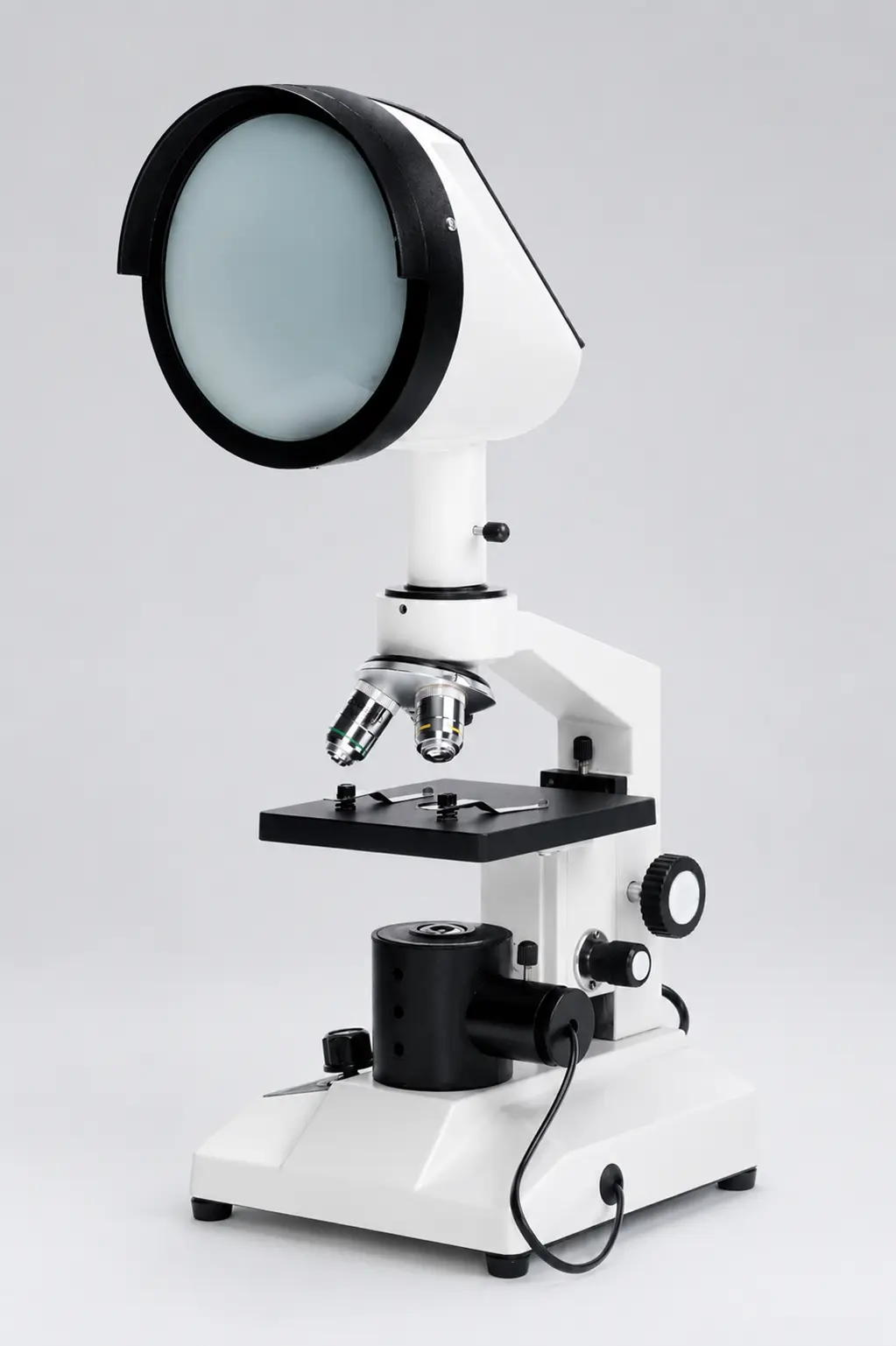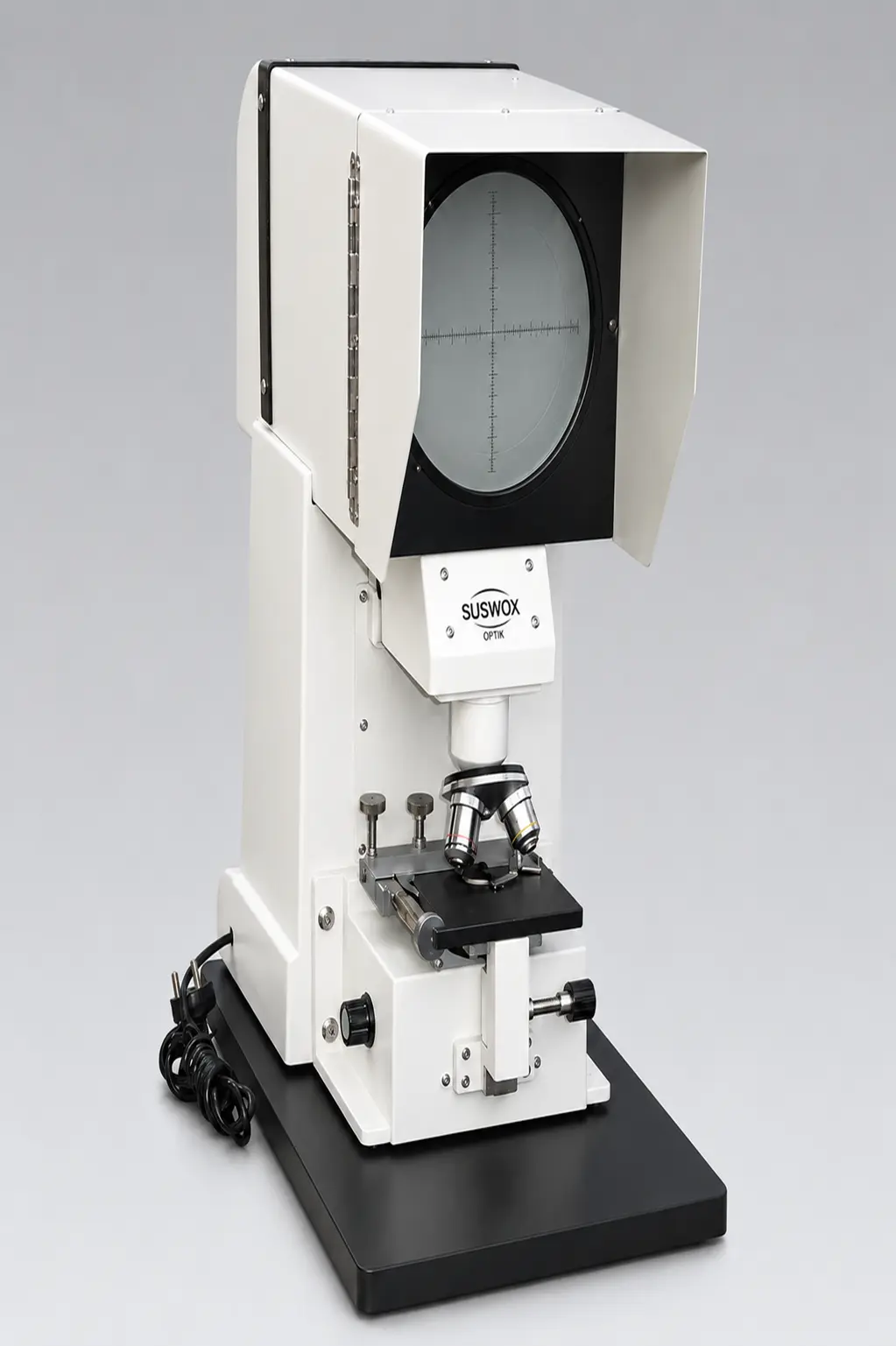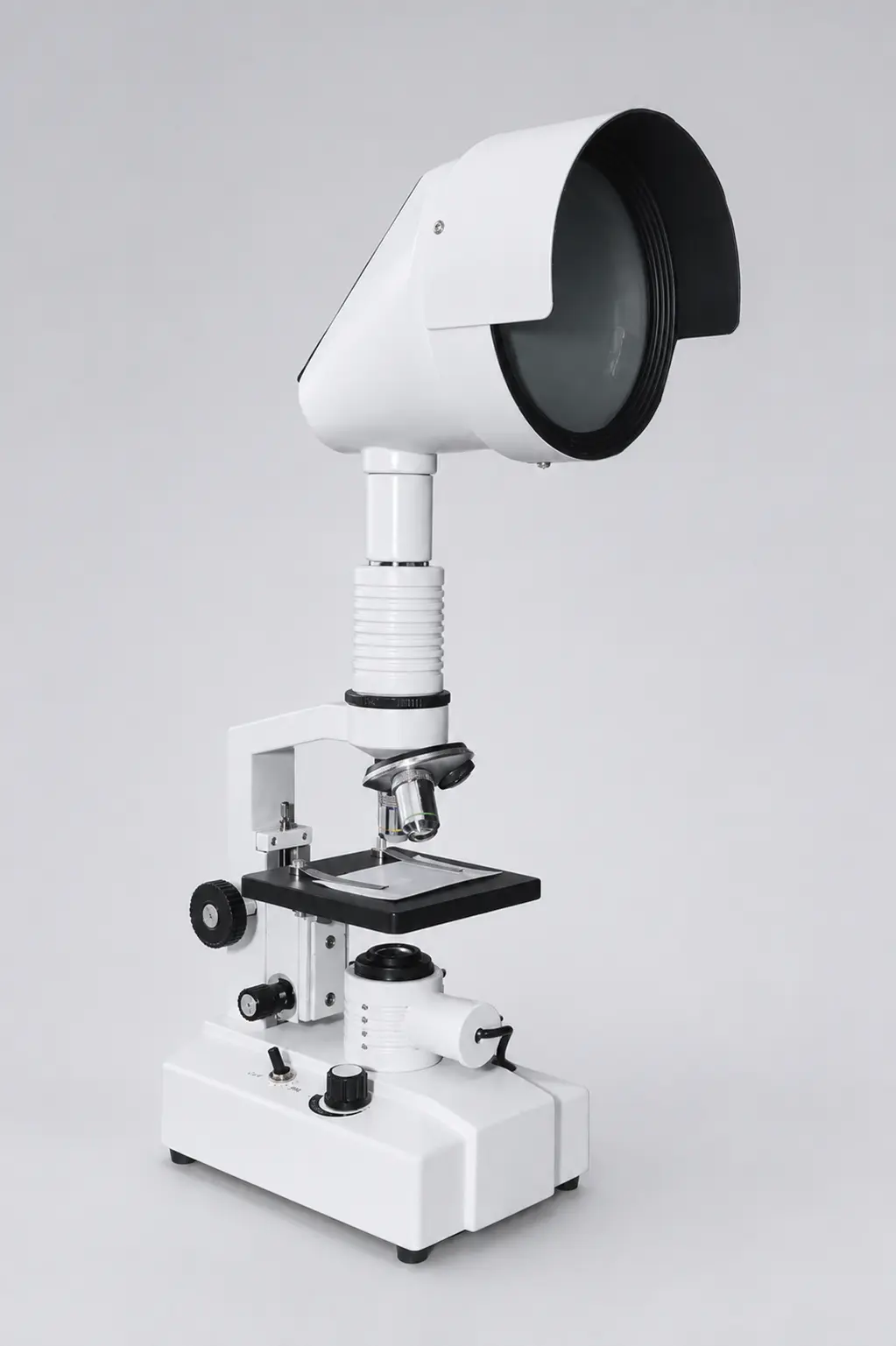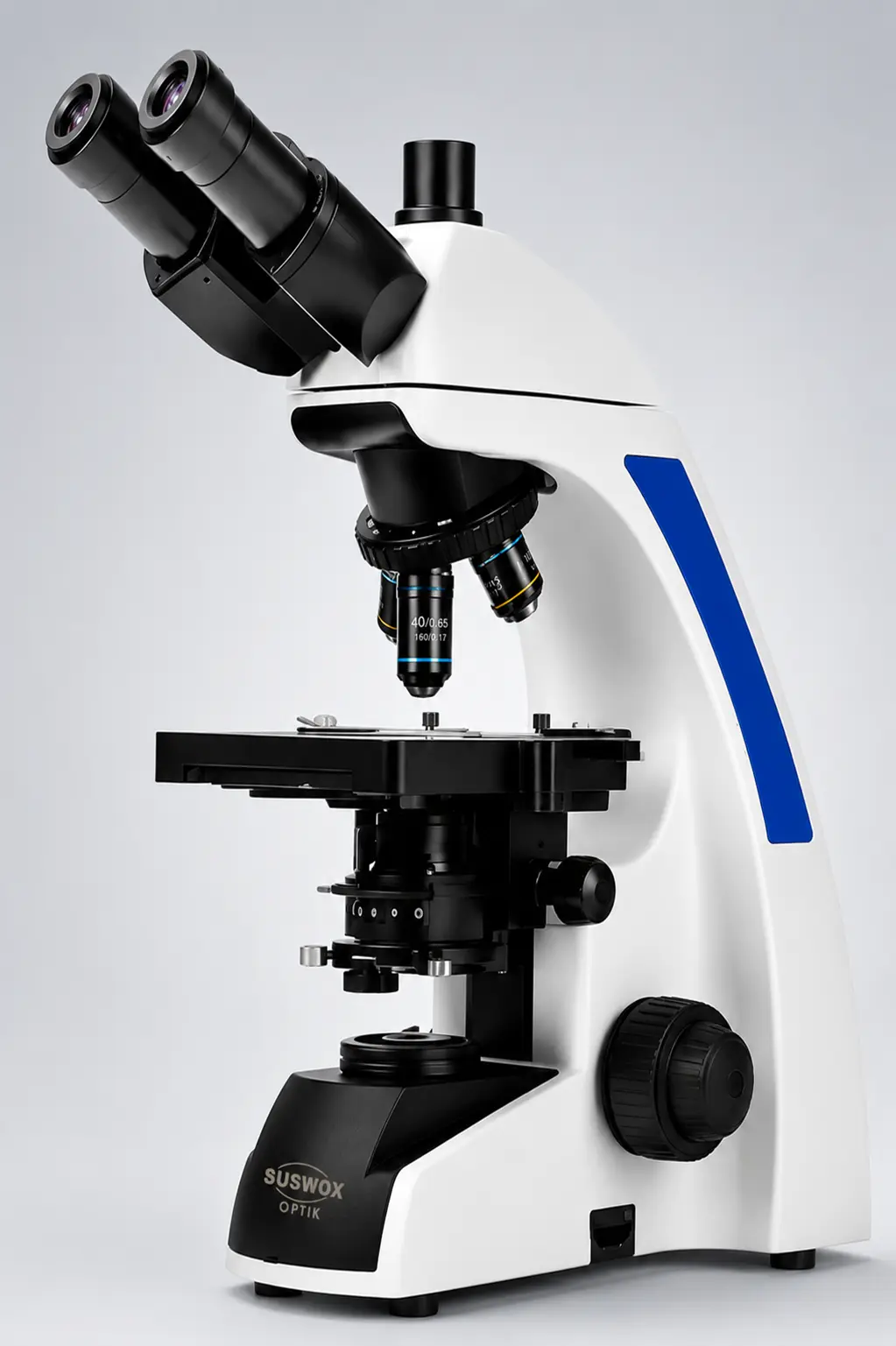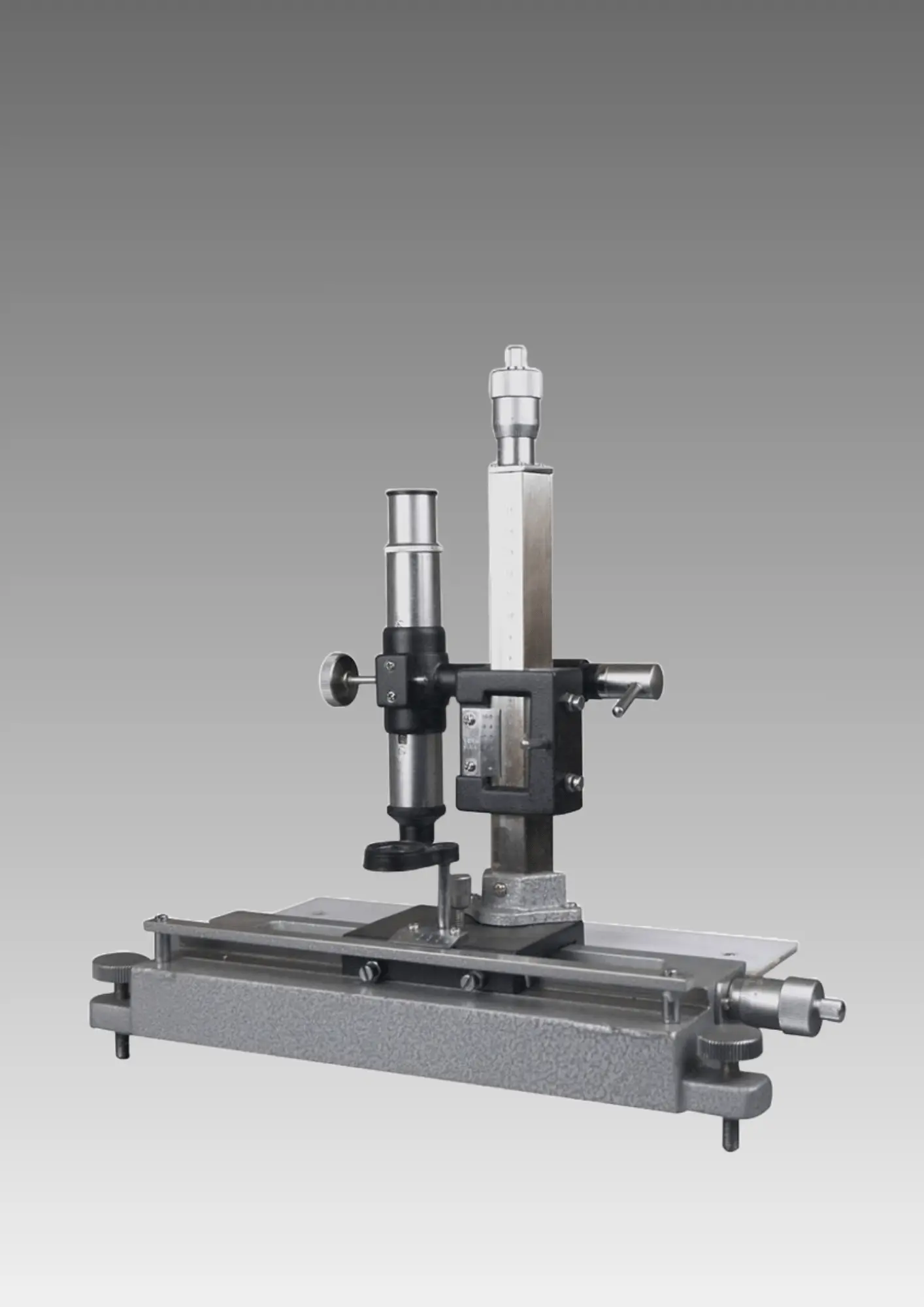
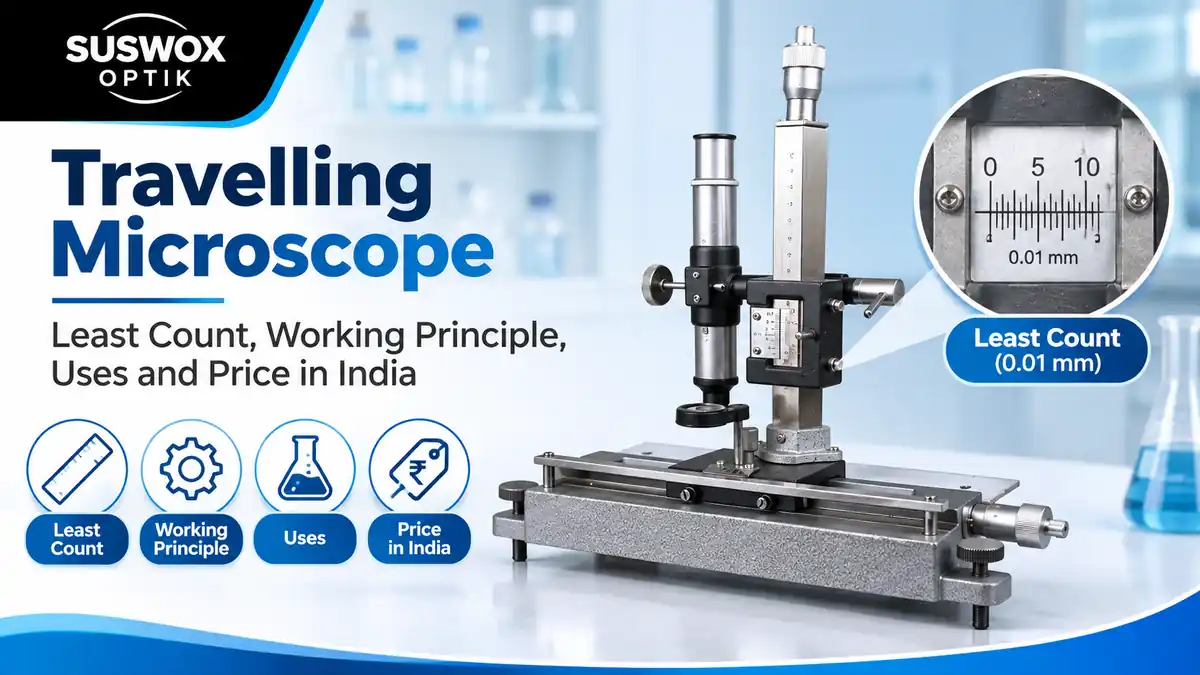
A travelling microscope is a measuring instrument, not a magnifier for viewing cells. It is a small microscope mounted on a carriage that slides along a scale with a vernier. You line up the cross-wire on one edge of an object, read the scale, move the microscope to the other edge, and read again. The difference gives the length, usually correct to 0.01 mm (0.001 cm).
That is why it sits in almost every college physics lab in India. It measures things too small for a ruler and too delicate for a screw gauge: the bore of a capillary tube, the rings in Newton’s rings, or the apparent depth of a mark under a glass slab.
Parts of a Travelling Microscope
| Part | What it does |
|---|---|
| Heavy base with levelling screws | Keeps the instrument steady and level |
| Vertical pillar with main scale | Lets the microscope move up and down for vertical readings |
| Horizontal bed with main scale | Lets the carriage move left and right for horizontal readings |
| Vernier scales | Give fine readings beyond the main scale divisions |
| Slow-motion (fine adjustment) screws | Move the microscope in very small steps for exact alignment |
| Microscope tube with objective | Forms the magnified image |
| Eyepiece with cross-wires | Shows the cross-wire you place on the object’s edge |
| Rack and pinion focusing | Brings the object into sharp focus |
Working Principle of a Travelling Microscope
The working principle of a travelling microscope combines two ideas:
- Magnification: The microscope magnifies the object so you can place the cross-wire exactly on an edge.
- Vernier measurement: The carriage moves along a main scale, and a vernier scale reads fractions of the smallest main scale division.
You take two readings, one at each edge, and the difference is the distance moved, which equals the size of the object. Because you never touch the object, it works for fragile items, liquids and things inside glass.
How to Find the Least Count of a Travelling Microscope
The least count of a travelling microscope is the smallest length it can measure.
Formula: Least count = value of one main scale division ÷ total number of vernier scale divisions
Example: On a common model, one main scale division (MSD) is 0.5 mm and the vernier has 50 divisions.
Least count = 0.5 mm ÷ 50 = 0.01 mm = 0.001 cm
Total reading = main scale reading + (coinciding vernier division × least count)
So if the main scale reads 32.5 mm and the 18th vernier division lines up with a main scale mark:
Reading = 32.5 + (18 × 0.01) = 32.68 mm
Always check the actual scale on your instrument. Some models use 1 mm divisions with a different number of vernier divisions.
Uses of a Travelling Microscope in Physics Experiments
- Refractive index of a glass slab: Measure the real depth and apparent depth of a mark. Refractive index = real depth ÷ apparent depth.
- Radius of a capillary tube: Measure the inner diameter of the bore for surface tension experiments.
- Newton’s rings: Measure the diameter of the dark and bright rings to find the wavelength of light or the radius of curvature of a lens.
- Thickness of a thin wire or glass plate.
- Small distances in engineering and metrology labs.
How to Use a Travelling Microscope: Step by Step
- Place the instrument on a firm table and level it with the base screws.
- Focus the eyepiece until the cross-wires look sharp.
- Place the object under or in front of the microscope and focus with the rack and pinion.
- Move the carriage until the vertical cross-wire touches one edge. Use the slow-motion screw for the final alignment.
- Note the main scale and vernier readings.
- Move to the other edge in the same direction only. This avoids backlash error.
- Take the second reading. The difference is the measured length.
- Repeat three times and take the average.
Travelling Microscope Price in India
The travelling microscope price in India depends on the scale length, the build and the least count. Based on listings from Indian makers in late 2026, typical ranges are:
| Type | Typical price range |
|---|---|
| Basic horizontal model, smaller scale | ₹3,500 to ₹6,000 |
| Standard lab model, horizontal and vertical motion, 0.01 mm least count | ₹5,000 to ₹10,000 |
| Heavy cast-iron, three-motion or long-scale models | ₹10,000 to ₹18,000 or more |
Watch out for very cheap listings. A wobbly carriage or a poorly cut vernier makes readings useless, however low the price.
SUSWOX SK-T2 Travelling Microscope
Our SK-T2 Travelling Microscope is built in Ambala for college and university physics labs. It has a cast-iron base, a horizontal range of 22 cm, a vertical range of 15 cm and two slow-motion knobs for accurate readings.
You can see it in our travelling microscope range. Schools and colleges setting up a full lab can also look at our student microscopes and our list of top 10 microscope manufacturers in India.
To learn how a regular lab microscope forms its image, read how a compound microscope works or our guide to types of microscopes.
Frequently Asked Questions
What is the least count of a travelling microscope?
The least count of a typical travelling microscope is 0.01 mm, or 0.001 cm. It is found by dividing the value of one main scale division by the number of vernier divisions, for example 0.5 mm ÷ 50.
What is a travelling microscope used for?
A travelling microscope is used to measure very small lengths accurately without touching the object. Common uses include the radius of a capillary tube, Newton’s rings diameters and the refractive index of a glass slab.
What is the principle of a travelling microscope?
It combines magnification with vernier measurement. The microscope is aligned on two edges of an object, and the difference between the two vernier readings gives the length.
Why is it called a travelling microscope?
Because the microscope travels, or slides, along a graduated scale while the object stays still.
What is the price of a travelling microscope in India?
Most travelling microscopes in India cost between ₹3,500 and ₹10,000. Heavier cast-iron or long-scale models can cost ₹10,000 to ₹18,000 or more.
Need travelling microscopes for a physics lab? Contact us for bulk pricing for colleges and schools.