
India’s Top Microscope Manufacturer — SUSWOX Since 1973
A microscope purchase can shape years of teaching, observation and laboratory work. Buyers need to
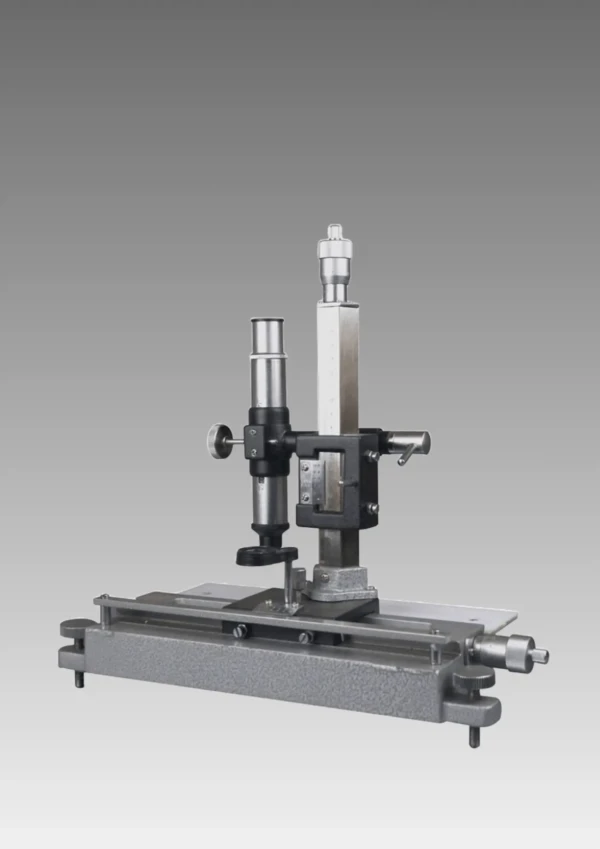
A travelling microscope is not really a viewing instrument. It is a measuring one. The eyepiece is there so you can place the crosswire exactly where you want it, and the reading you take off the vernier is the whole point of the exercise.
SUSWOX is a travelling microscope manufacturer in India, building these instruments at our own unit in Ambala, Haryana since 1973 under the name Sudheer Scientific Works. The optics, the vernier scales, the base casting and the fine motion screws are made and assembled here, then checked against a standard before the instrument is packed. That matters more on this product than on almost any other, because a travelling microscope with a sloppy lead screw gives readings that look perfectly reasonable and are quietly wrong.
Physics departments in colleges and universities across India buy from us directly, and our institutional list includes BHU, MDU Rohtak, AIIMS Bathinda, AIIMS Nagpur and the Haffkine Institute. Browse the models below, download the catalogue, and send your requirement. As a travelling microscope supplier and exporter we quote in writing, usually within one working day, and bulk pricing applies to college laboratory orders.
A microscope purchase can shape years of teaching, observation and laboratory work. Buyers need to

Type “binocular microscope” into any shopping site and you will see prices from about ₹7,000

You cannot turn a culture flask upside down and put it on a slide. That
A travelling microscope is a low-power microscope mounted on a graduated vertical and horizontal scale, used to measure small distances that cannot be measured with a scale or a vernier caliper. The microscope moves along the scale, and the displacement is read off the main scale and vernier together, usually to 0.001 cm.
In a physics practical it turns up again and again. Refractive index of a glass slab, capillary rise, the radius of curvature in Newton’s rings, surface tension experiments, the diameter of a capillary tube — most of these depend on a travelling microscope reading, and the accuracy of the whole experiment is limited by the accuracy of the instrument.
Which is exactly why a college should not buy the cheapest one available. A student who takes a careful reading on a bad instrument still gets a bad result, learns the wrong lesson about experimental error, and blames themselves for it.
Start with the vernier and the least count. Most physics syllabi expect readings to 0.001 cm, so confirm the least count on the model you are quoting for, both on the vertical and the horizontal scale.
Then the movement. The fine motion screw should move the carriage smoothly with no play and no jump at the start of a turn. Backlash in the screw is the single most common source of wrong readings in a student lab, and it is a manufacturing issue, not a handling one.
And then the base. A heavy, properly levelled base with adjusting screws keeps the instrument stable through a full practical batch. Light bases move, and once the instrument has shifted mid-experiment, every reading after that is worthless without anyone noticing.
Most travelling microscope orders that reach us are for a full batch — ten, twenty, sometimes forty units for a physics block or a university department under tender. The questions are always the same: consistency across units, bulk price, and how quickly spares arrive when a screw or an eyepiece is damaged three years later.
We build these instruments ourselves, so units in one order come from the same production run and behave the same way, which is important when a class compares results across benches. Spares stay available for our models long after the warranty period, and service goes through our own team.
SUSWOX supplies against government tenders and GeM orders with proforma invoices, technical compliance sheets, OEM certificates and authorisation letters. Fifty years as a microscope manufacturer in India means most of the tender paperwork you are about to ask for is already sitting ready with our sales team.
A travelling microscope is a precision measuring instrument consisting of a low-power microscope mounted on a graduated vertical and horizontal scale with vernier scales. It is used in physics laboratories to measure very small distances and displacements accurately, typically to 0.001 cm.
It is used for experiments such as finding the refractive index of a glass slab, measuring capillary rise, determining the radius of curvature in Newton’s rings, and measuring the diameter of small tubes and wires where an ordinary scale is not accurate enough.
A manufacturer. We produce travelling microscopes at our own unit in Ambala, Haryana and have done so since 1973 as Sudheer Scientific Works. Optics, scales, castings and mechanical assembly are handled in-house and every instrument is checked before dispatch.
The price depends on the least count, the scale range and the build of the base and carriage. College and bulk orders are quoted separately — send us the quantity and specification and we will share an exact quote with GST and delivery timelines.
Our standard models read to 0.001 cm on the vernier, which meets the usual requirement for undergraduate physics practicals. If your syllabus or tender specifies a different least count, tell us and we will quote the matching model.
Yes, that is most of what this category sells. We supply physics departments, university laboratories and state tenders, with units from the same production run so readings stay consistent across benches, and phased delivery where required.
Standard models dispatch within three to five business days of order confirmation. Bulk institutional orders take longer depending on quantity, and we confirm the exact schedule in writing before booking.
Yes. We supply universities and colleges across Africa, South Asia and the Middle East. Send your country and requirement to sales@suswox.com and our team handles documentation and freight.