
Binocular Microscope Price in India (2026): Student, Pathology and Research Models
Type “binocular microscope” into any shopping site and you will see prices from about ₹7,000
A culture flask cannot be turned upside down and put on a slide. That single practical fact is why the inverted microscope exists — the objectives sit below the stage and look up through the base of the vessel, so cells can be examined while they are still growing in medium.
SUSWOX is among the inverted microscope manufacturers in India, producing these instruments at our own unit in Ambala, Haryana since 1973 under the name Sudheer Scientific Works. The optical train, the long working distance condenser, the stage and the mechanical assembly are built and tested here rather than imported and relabelled.
Tissue culture laboratories, research departments and hospital units order from us directly, and our institutional list includes AIIMS Bathinda, AIIMS Nagpur, BHU, MDU Rohtak and the Haffkine Institute. Browse the models below, download the catalogue, and send us your requirement. As an inverted microscope supplier in India and exporter, we reply with a written quotation covering configuration, GST and delivery, usually within one working day.
Type “binocular microscope” into any shopping site and you will see prices from about ₹7,000

You cannot turn a culture flask upside down and put it on a slide. That

Ask five sellers for a stereo zoom microscope price and you will get five very
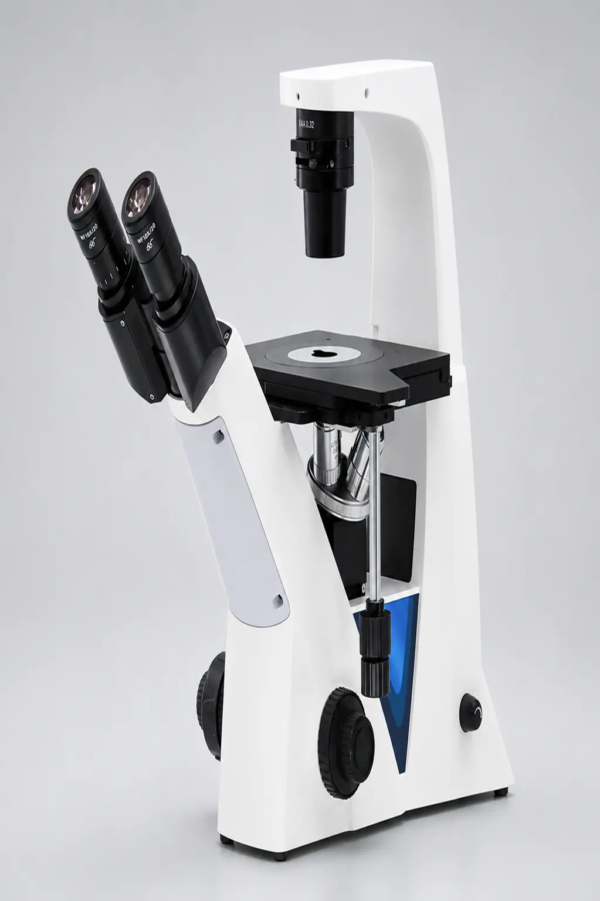
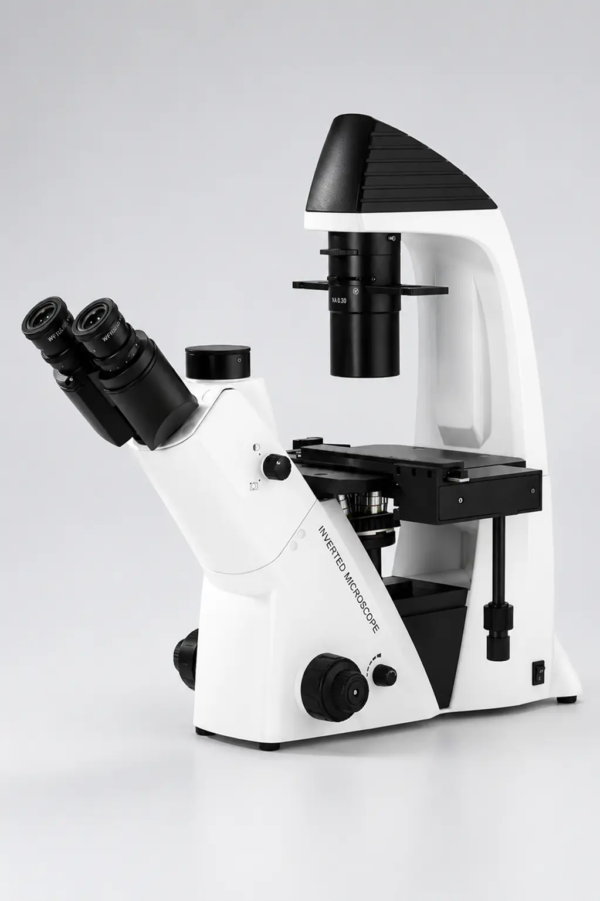
An inverted microscope has its objective lenses positioned beneath the stage and its illumination above, so specimens can be viewed from below through the bottom of a culture flask, petri dish or multi-well plate. It is used mainly in cell culture, tissue culture, microbiology and materials work where the sample sits in liquid or in a container that cannot be inverted.
The day-to-day use is monitoring. Checking whether a monolayer has reached confluence, looking for contamination early, watching cell morphology across passages. None of this is glamorous work and all of it is constant, which is why the ergonomics of the instrument end up mattering as much as the optics.
Materials laboratories use inverted models too, for examining polished metallurgical samples that are too heavy or too flat to mount conveniently on an upright stage.
Look at the working distance first. The optics have to focus through the plastic base of a flask and still reach the cells, and a condenser with a short working distance simply will not clear a standard culture vessel.
Then phase contrast. Live unstained cells have almost no contrast in brightfield, so most culture labs specify phase contrast from the start rather than adding it later. If your work involves anything beyond a quick confluence check, take it.
Then the head. A trinocular port lets you attach a camera for documentation and for sharing images without moving the flask, which in a culture room is worth more than it sounds — every transfer between instruments is another chance to contaminate a plate.
And finally the stage. Flasks, dishes and plates are different sizes, so the stage and its inserts need to hold whatever your lab actually uses. Tell us the vessel types and we will specify the stage accordingly.
An inverted microscope in a working culture lab runs for years with very little downtime tolerance. When something does go — an illumination unit, a phase ring, a stage insert — the question is how long the lab waits.
We manufacture these instruments, so spares for our models stay available long past the warranty period and service is handled by our own engineers rather than routed through a distributor chain. Tender documentation comes from the factory as well: proforma invoices, technical compliance sheets, OEM certificates and authorisation letters. Fifty years as a microscope manufacturer in India is largely why government institutions keep SUSWOX on their approved lists.
An inverted microscope is a microscope with the objectives placed below the stage and the illumination above it, so samples are viewed from underneath. This arrangement allows cells to be examined inside culture flasks, petri dishes and multi-well plates without transferring them to a slide.
In a standard upright microscope the objectives sit above the stage and the specimen is viewed from the top, which suits slides. In an inverted microscope the optics look up from below, which is the only practical way to examine living cells in a liquid medium inside a culture vessel.
A manufacturer. We have produced microscopes at our own unit in Ambala, Haryana since 1973 as Sudheer Scientific Works. Optical assembly, mechanical fabrication, alignment and testing are all carried out in-house.
It depends on the optical configuration, whether phase contrast is included, the viewing head and any camera attachment. Send us your application and quantity and we will share an exact quotation with GST and delivery timelines.
For live unstained cells, yes in most cases. Living cells produce very little contrast in brightfield, so phase contrast is what makes morphology visible. Labs doing only quick confluence checks sometimes manage without it, but it is usually specified from the start.
Yes. A trinocular head takes a digital camera on the third port so images can be captured without disturbing the viewing path or moving the flask. We supply matching camera attachments and can quote both together.
Yes. SUSWOX supplies research institutes, universities and government laboratories through tender and GeM processes, with proforma invoices, technical compliance sheets, OEM certificates and authorisation letters provided as required.
Yes. We ship to laboratories and institutions across Africa, South Asia and the Middle East. Write to sales@suswox.com with your country and requirement and we will handle documentation and freight.