Top 10 Microscope Manufacturers in India (2026)
A lab technician in a small pathology centre once said something worth repeating: the report
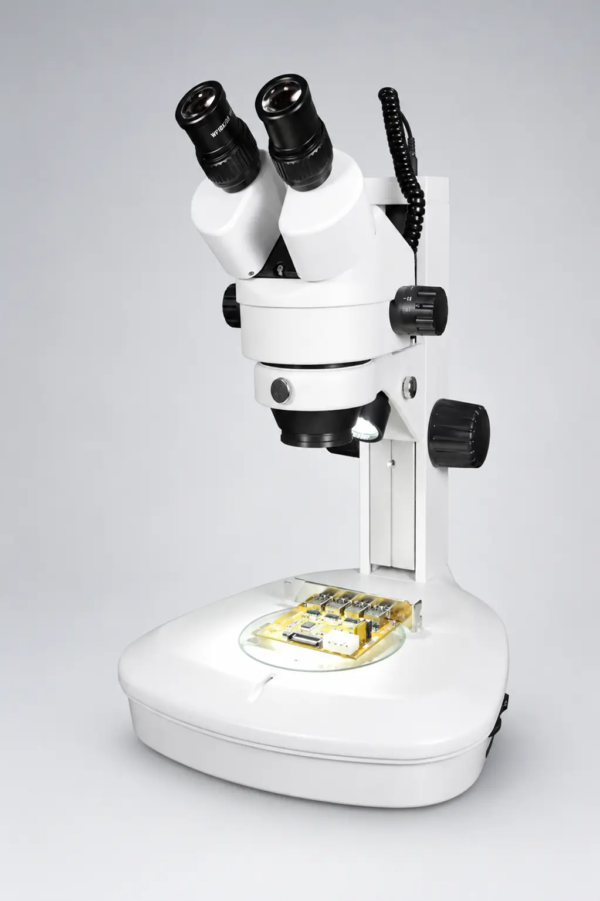
Put a circuit board under a compound microscope and you get a beautifully magnified image of something you cannot work on. There is no room for a hand, no depth to the image, and the board is upside down and back to front when you move it.
That is the gap a stereo zoom microscope fills. Two separate optical paths give a genuinely three-dimensional view, the working distance leaves space for a soldering iron or a pair of forceps, and the zoom lets you move between overview and detail without changing objectives.
SUSWOX is a stereo zoom microscope manufacturer in India, building these instruments at our own unit in Ambala, Haryana since 1973 under the name Sudheer Scientific Works. Electronics units, gemologists, biology departments and quality control labs buy from us directly, and our institutional list includes AIIMS Bathinda, AIIMS Nagpur, BHU, MDU Rohtak and the Haffkine Institute. Browse the models below, download the catalogue, and send your requirement — as a stereo zoom microscope supplier in India and exporter, we quote in writing, usually within one working day.
A lab technician in a small pathology centre once said something worth repeating: the report

A lab assistant once handed me a 100x objective that had been sitting with dried
Switch on the lamp. Put the slide on the stage. Turn the coarse knob until
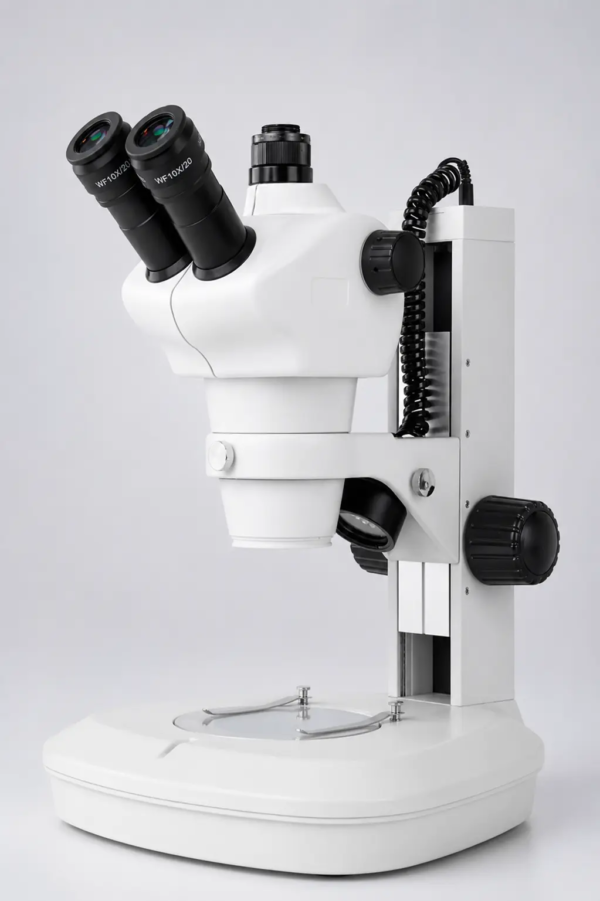
A stereo zoom microscope provides a low-magnification, three-dimensional view of solid objects with a continuously variable zoom range. It is used for inspection, assembly, dissection and repair work — anywhere the object is opaque, the magnification needed is modest, and the hands have to reach the sample while it is being viewed.
Electronics is the largest single use. PCB inspection, component placement, rework and solder joint checking all need depth perception and working space, and neither is available on a compound instrument.
Beyond that, the same instrument turns up in gemology for stone inspection, in biology departments for dissection work, in entomology, in watch and jewellery repair, and on the quality control bench of small manufacturing units checking welds, threads, moulded parts and surface finish.
The zoom range decides how the instrument feels in use. A continuous zoom lets an operator find the object at low magnification and move in without losing it, which sounds minor until you have watched someone hunt for a component after switching objectives.
Working distance decides whether the instrument is usable at all for your task. Soldering, dissection and assembly need space between the objective and the sample, and if the specification does not give you that, the microscope becomes an inspection-only tool.
Illumination usually needs both. Incident light from above shows surface detail on opaque objects, and transmitted light from below suits translucent samples and dissection trays. Most inspection benches end up wanting a ring light as well, which gives shadow-free illumination across the whole field.
And if images have to be recorded — for a QC report, a customer complaint, or a teaching file — take a trinocular head and add a camera. It costs less than being asked for photographic evidence you cannot produce.
A stereo microscope on a production line works a full shift, every shift. Focus mechanisms wear, illumination units fail, and the arm eventually needs adjustment — normal things, all of which need parts.
Because we build these instruments, spares for our models stay available well beyond the warranty period and service is handled by our own engineers. For government and institutional buyers, tender documents come straight from the factory too. That combination is why so many purchase departments treat SUSWOX as a default among stereo zoom microscope suppliers, and why our reputation as a microscope manufacturer in India rests more on instruments still running after fifteen years than on any specification sheet.
A stereo zoom microscope is a low-magnification microscope with two separate optical paths that produce a three-dimensional image of a solid object, along with a continuously variable zoom range. It offers a long working distance, which allows hands and tools to reach the sample during viewing.
A compound microscope gives high magnification of thin, transparent specimens on a slide and produces a flat, two-dimensional image. A stereo microscope gives lower magnification of solid objects in three dimensions with far more working space, which is what inspection and dissection work needs.
A manufacturer. We produce these instruments at our own unit in Ambala, Haryana and have done so since 1973 as Sudheer Scientific Works. Optics, mechanical assembly, illumination and testing are all in-house.
It depends on the zoom range, the stand type, the illumination configuration and whether a camera is included. Send us the application and quantity and we will share an exact quotation with GST and delivery timelines.
Look for a continuous zoom, a long working distance so a soldering iron can reach the board, and ring light illumination for shadow-free viewing. Tell us the board sizes and the work being done and we will suggest the configuration.
Yes. A trinocular head accepts a digital camera on the third port for inspection records, quality reports and teaching. We supply matching camera attachments and can quote the microscope and camera together.
Yes. SUSWOX supplies universities, government laboratories and institutions through tender and GeM processes, and provides proforma invoices, technical compliance sheets, OEM certificates and authorisation letters as required.
Yes. We ship to industrial units, laboratories and institutions across Africa, South Asia and the Middle East. Send your country and requirement to sales@suswox.com and we will handle documentation and freight.